



[ad_1]

Last week was a tough week for Ukraine. The nation’s cities suffering drone and missile strikes while Ukraine’s army defends the current border from fierce Russian ground attacks. Meanwhile in the US, political differences continue to stall additional aid. After weeks of speculation, President Volodymyr Zelensky removed his top general, Valerii Zaluzhnyi and is re-structuring Ukraine’s military command structure. Meanwhile, Russia is massing a large force near the important city of Kupiansk.
American journalist Tucker Carlson provided the week’s biggest mainstream news story, visiting Russia and interviewing Vladimir Putin. An interview that provided no new information, but confirmed Putin’s views on Ukraine’s independence and provided an opportunity to speak directly to Carlson’s audience. Putin reinforced key narratives that Russian intelligence has spent years crafting and disseminating in the US. Specifically, that Ukraine is part of Russia, that Ukraine is a distant war of little importance to Americans, that America risks being drawn into direct confrontation with Russia in Europe, over a war Russia will win.
Putin’s long dialogue was historically inaccurate, but other commentators can provide better analysis of his statement. My assessment is focussed on the military arguments. First, that Russian success is guaranteed. Russia’s economy before the war was marginally larger than Australia’s, its population is half the size of the US and its vaunted war-machine has proven ineffective dwarfed by US and NATO military power and unable to defeat Ukraine. Authoritarianism and corruption have killed intellectualism and innovation in the nation and leadership in the military. Putin’s bluff is based on the West’s long-seated fear of Soviet military power. A well-founded fear at the time, however the world has moved on and regardless of Putin’s desire to re-create the Soviet Union that time has passed. Russia is not unbeatable.
Second that by supporting Ukraine, America is de-stabilising Europe and risks being drawn into the war. History shows that not supporting Ukraine, increases the risk of direct confrontation with Russia. In 2014, NATO and the US did not support Ukraine and by demonstrating weakness, the alliance incentivised the future use of force by Russia, and in 2022 Putin’s tanks entered Ukraine. If US partners and allies cannot rely on support against aggression, Europe and the world become less stable. This means that in the future, the US is more likely to be drawn into a war on the continent. It makes sense for the US to support peace and stability in Europe by supporting Ukraine because it demonstrates that unilateral aggression by large nations will be opposed, dis-incentivising this behaviour,
Unfortunately, Carlson’s interview provides a platform for Putin to speak directly to a large group of Americans, who influence political leaders. Now more than ever it is important that media provides good analysis to counter propaganda.
Ukraine’s military leadership changes
Rumour of a split between Zelensky and Zaluzhnyi have circulated since last year. It is impossible for any commentator to make informed commentary about their relationship because unless you are in the ‘inner circle’ it is impossible to understand the actual dynamics of their relationship.
However, it is possible to speculate on the impact of these changes. General Zaluzhnyi is enormously popular in Ukraine and appeared to have a good relationship with allied powers. He also delivered significant operational successes; organising the initial defence of Ukraine, the destruction of Russia’s Black Sea Fleet and the Kherson and Kharkiv offensives. However, last year’s offensive failed to meet its objectives; a failure exacerbated politically by the large amount of international support Ukraine received.
After much strategizing, planning and wargaming with US, UK and NATO advisors, Ukraine choose to attack simultaneously on several axes. An unexpected choice, and a plan that did not match NATO doctrine. Somewhere in Ukraine, a decision was made not to follow this advice. A range of arguments can be made for ignoring NATO doctrinal advice that in my opinion would be difficult to defend logically, or tactically. Therefore, either the Ukrainian military made a bad decision or politics entered the military discussion.
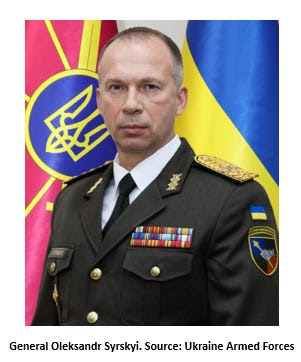
But will this change effect Ukraine’s campaign? The short answer is that we do not know yet. Changing military leadership mid-campaign is always a risky option but it takes time for a change’s impact to filter through into the campaign. General Oleksandr Syrskyi, General Zaluzhnyi’s replacement is a very capable leader, commanding Ukraine’s land forces during the war and is reported to strategist behind the 2022 Kharkiv Offensive. Additionally, President Zelensky’s changes include promotion of several young, battle-hardened officers to senior positions.
The US political situation and its implications for Ukraine, and the world
On Thursday last week, the US Senate voted to start considering an amended emergency aid package, that includes US$ 60 billion for Ukraine. This vote means that although the aid package’s progress is currently blocked by Republicans, it may still be authorised.
This debate is very important because the world’s rules-based order, or the international forums like the UN and its subsidiary agencies that support peaceful dialogue and trade between nations are all underwritten by the US. US money finances the UN and the International Monetary Fund, its navy polices the world’s oceans and US military power deters aggression.
If the US steps back, and stops playing this role the potential for chaos and conflict in the world increases enormously. Unfortunately, this is what appears to be happening. America’s position as the ‘leader of the free-world’ is being sacrificed in bi-partisan squabbling. Many Republicans support the Ukrainian cause but vote against the President’s bill to achieve a ‘win’ for the Republican faction. Sadly, the implications are severe. Not just for Ukraine but for the world.
In a surreal development that demonstrates the power of social media and information war, Donald Trump, after inciting a mob to storm the US Capitol and while facing numerous criminal charges is the front-running Republican candidate for US President. Trump is an avowed isolationist with a limited world-view. His potential election is a factor in the Republicans wavering support for Ukraine and is also an indicator of increasing domestic stability in the US.
But will Ukraine lose without American support? History demonstrates that this is unlikely, Ukrainians are strongly opposed to their country being subsumed by Russia and will continue to fight. Ukraine has the potential to build a strong defence industry and on 9 February, Bloomberg reported that the country is taking steps to re-structure its economy (probably aiming to reduce corruption) so that it can receive International Monetary Fund support.
Further, Europe understands the threat and is increasing its support to Ukraine. Recently committing another 50 billion euros to the campaign. This brings the European Union’s total commitment to 138 billion euros or about US$ 148.5 billion, more than matching the US commitment of US$ 113 billion to date. The European Union has enough resource to support Ukraine without the US. However, supporting Ukraine to continue a long and costly war with Russia is very different from providing the means to win in the shortest time possible. Only America’s military industrial base can provide that level of support.
Unfortunately, the impact of the US not supporting Ukraine’s defence is most likely to be felt far away. In places like the South China Sea or Taiwan. Any uncertainty about US willingness to support partners or allies incentivises China to be more assertive. A much bigger threat to stability than Russia.
Ukraine’s campaign against Russian infrastructure
Ukraine continues to attack Russian infrastructure, especially Russia’s oil facilities. The campaign involves attacks by drones and saboteurs on armament factories, rail lines, power infra-structure, logistics depots and oil facilities. The attacks are widespread, targets ranging across Russia. Even as far away as Vladivostok, on the Pacific Coast where two electrical sub-stations were destroyed on 23 January.
The campaign has two goals; operationally it aims to limit the flow of military supplies into Ukraine, and strategically it aims to cripple Russia’s economy by stopping the flow of oil. Reducing Russia’s oil exports reduces its income and therefore the nation’s ability to pay for the war.
Ukraine is currently targeting oil facilities in a wide-range of places and at vast distances from Ukraine. Some of the targets it is hitting should be well-protected, for instance near St Petersburg or Russia’s largest refinery in Volgograd. The strategic nature of these attacks is confirmed by strikes at export focussed sites like the depot and Rosneft refinery at Tuapse, on the Black Sea and the Novatek processing plant on the Baltic coast. Indicating that reducing Russia’s ability to export oil is an objective of the campaign.
Ukraine’s strikes in Russia fall into two general types; targets of opportunity and coordinated attacks. Ukraine is probably encouraging and supporting a wide-range of anti-Putin groups across Russia that carry out sabotage attacks and provide intelligence about target. This activity is likely to be less coordinated but creates a security problem for Russian. On the other hand, Ukraine’s attacks on oil production and export infrastructure appear to be planned and coordinated, and typically use drones. The map below shows the recent attacks on oil facilities, indicating the extent of the campaign and its coordination.
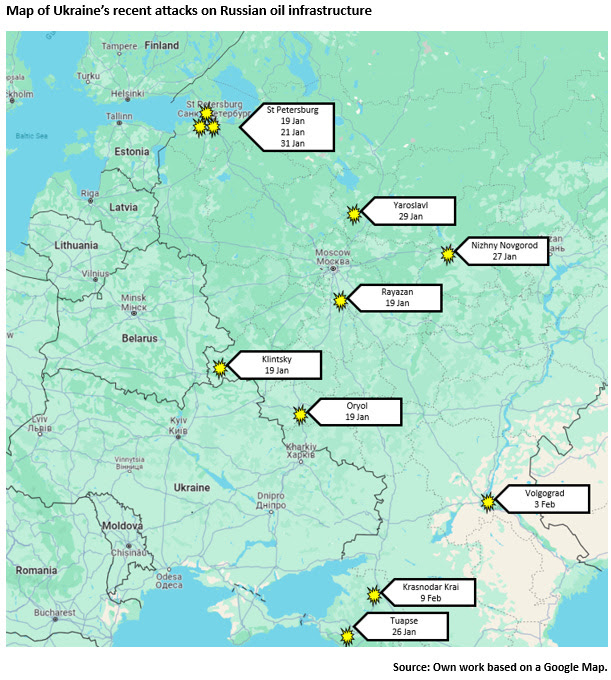
This campaign should be noted because it provides a glimpse of future conflict. Ukraine’s drones are hitting targets spread over a frontage of approximately 1,700 km, roughly the distance between Hobart and Brisbane in Australia, and often 800km behind Russian lines. The use of long-range drones to provide a relatively inexpensive weapon to attack economic targets will increase in the future.
Russia masses in the north east targeting Kupiansk
Kupiansk is an important city in north-east Ukraine, it is a major road and rail junction that played a key part in the 2022 Kharkiv campaign. Additionally, it is a crossing point on the Oskil River. Capturing the city provides a logistics base for an advance either; west toward Kharkiv or south towards Lyman, Sloviansk and Kramatorsk.
If Russia advances west from Kupiansk, towards Kharkiv then it can use the P07 Highway as a main supply route as it advances roughly 80km through relatively open terrain. Going south, the P79 Highway provides a main supply route for an advance and the Oskil River can be used to secure the flank of an advance in this direction. Both options are workable, however Russia must first take the city.
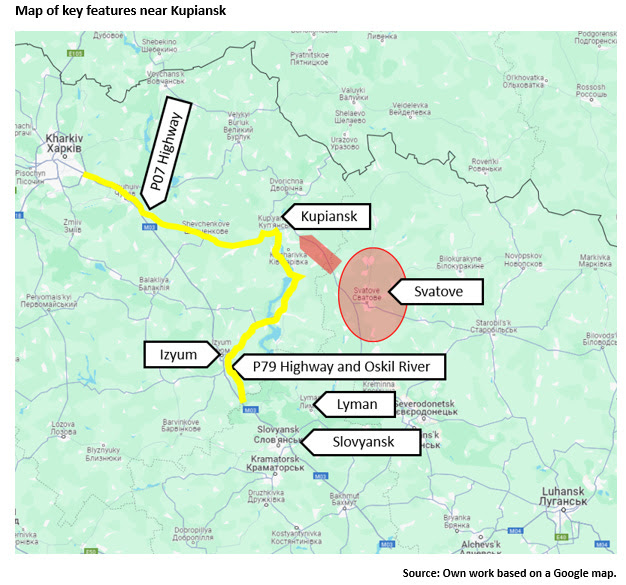
Ukraine reports that Russia is currently massing forces, just east in the area around Svatove, approximately 40,000 troops supported by 500 tanks. This is a significant force and its position indicates that an attack on Kupiansk is likely. The next question is whether this force can capture the city. My assessment is that this is highly unlikely, Russia has thrown similar sized forces at Avdiivka since October without success. General Zaluzhnyi, along with many other commentators are currently discussing the increasing advantages that drones and other technology give the defenders in battle. Defeating this advantage is difficult and Russian performance on the offensive to-date has not demonstrated that they can. Therefore, my assessment is that this reported build up is either; Ukraine trying to present a threat to encourage more support, or may the start of another failed Russian offensive.
Summary
Despite Putin’s sang froid during his interview with Tucker Carlson, Russia’s situation is far from stable. The Russian economy is fully mobilised to support the war and there is nothing left in the cupboard. The effect of the war on the wider economy is enormous and to-date has been managed by a large war-chest, and by continuing to export oil and gas. Late last year, Russian oil revenue had dropped by 26%. Ukraine’s oil campaign aims reduce this revenue further, and making war costs money.
In theatre, the Black Sea Fleet is ineffective forced back into safe harbours. Russia’s tactical airpower is increasing ineffective driven back from the front lines by superior Western anti-aircraft missiles, and will soon be facing F-16 fighters. Ukraine is working hard to isolate Crimea and recent attacks on the peninsula demonstrate that Russia’s air defence surveillance network is being effectively reduced. On land, Ukraine is still holding its post-2023 offensive frontline, regardless of ammunition shortages and Russia’s sacrifice of tens of thousands of young soldiers since October.
Essentially, Russia is in trouble and is not be able to continue this war forever. Putin is playing on a myth of Russian intractability and willingness to endure, while presenting an image of confidence aiming to outlast US and European support for Ukraine. However, that confidence is a bluff, based on myth rather than reality.
Ben Morgan is a bored Gen Xer, a former Officer in NZDF and TDBs Military Blogger – his work is on substack

[ad_2]
Source link
