



[ad_1]
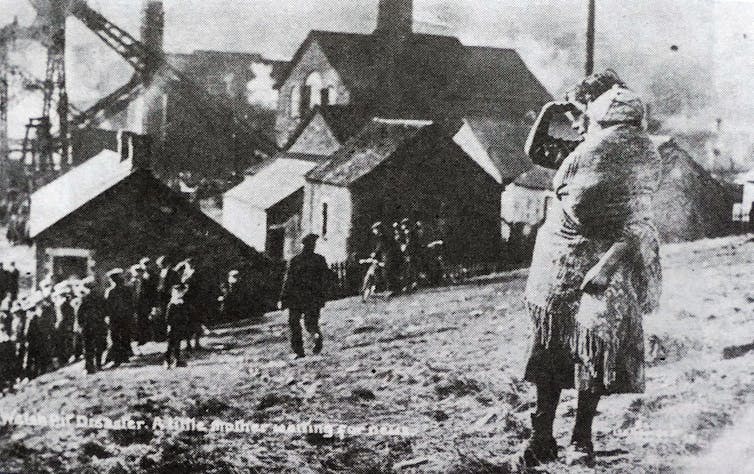
Miners working at the Universal Colliery in Senghenydd, south Wales, were in the middle of their morning shifts 2000ft below the ground when a massive explosion ripped through the deep pit at 8.10am. A spark from an electric bell had ignited a deadly mix of methane gas and coal dust, known to miners as “firedamp”.
The blast on October 14 1913 killed 439 men and boys, with another dying during rescue operations. It was, and remains, the worst coal mining disaster in British history and also the sixth worst in the world.
But disasters of this dreadful nature occurred with dismal regularity in the south Wales coalfield when the industry was at its height. South Wales was the most dangerous coalfield in what was statistically the most dangerous industry in the UK at that time.
Only a few miles away from Senghenydd, 290 miners had died in an explosion at the Albion Colliery in Cilfynydd in 1894. The Universal Colliery had itself suffered an earlier explosion, in 1901, which killed 81 miners.
Everyone in Senghenydd lost family or friends in the 1913 disaster. It left 542 children fatherless and made widows of more than 200 women. Ninety boys and young men aged 20 or less were killed, with the youngest victims being just 14 years old. One chapel in the village reportedly lost 60% of its male members.
World History Archive/Alamy
Although Senghenydd bore the brunt of the tragedy, its deadly effects were also felt further afield. A sizeable minority of the miners who were killed lived in the neighbouring village of Abertridwr and other nearby villages, while ten lived as comparatively far away as Cardiff.
The 1911 Census shows a large number of families and individuals from every part of Wales living or lodging in Senghenydd. It also shows that many of those who were killed in the disaster had come to the village from England and some from Ireland.
Justice?
From the perspective of mining families, the official investigations into the disaster added insult to injury. The coroner’s inquest into the disaster returned a verdict of accidental death.
Following the inquest, the colliery’s manager was prosecuted for 17 breaches of the Coal Mines Act, while the company was charged with four breaches. But most of those charges ended up being dropped.
The manager was eventually fined a total of £24 and the company was fined £10 with £5 and 5 shillings costs. As the Merthyr Pioneer newspaper reported: “Miners’ lives at 1s 1¼d each” –- the equivalent of 5.5p per dead miner in today’s money.
The Universal Colliery went back to work at the end of November 1913. It eventually closed in 1928 and the derelict site was demolished in 1963.
In 2013, on the 100th anniversary of the disaster, the Welsh National Mining Memorial was unveiled on the old colliery site, to commemorate miners killed in the Senghenydd disasters and also to remember the victims of the other 150 mining disasters in Wales.
Hundreds of people gathered to pay their respects and to view the unveiling of the memorial. The scale of the public turnout to the commemoration showed the extent to which the people of the south Wales valleys are still aware of the terrible toll of death and injury that the industry inflicted upon its workforce.
The memorial statue itself depicts a rescue worker helping an injured miner. Surrounding the statute is a walled garden, with tiles inscribed with the details of those killed in the two Senghenydd disasters as well as a “path of memory”, which marks other colliery tragedies in Wales.
Although the disaster was widely reported at the time, it faded from memory for most people and is not well known beyond Wales by now.
It is possible that this was due to it being eclipsed by the outbreak of the first world war less than a year later. Or perhaps it was because there were just so many colliery disasters that memory of it merged into a broader, vaguer memory of death and danger in the coalfields.
Remembering
Although the collieries are all long gone now, mining disasters continue to retain a contemporary resonance in the folk memory of the south Wales coalfield region.
This was seen in popular responses to a coal tip landslide in Tylorstown in 2020, which is just 11km away from Senghenydd. It was reflective of the visceral horror at the Aberfan disaster of October 1966, in which 116 children and 28 adults were killed when a coal tip slid downhill onto a primary school.
Such latter-day commemoration, as often as not via social media nowadays, is perpetuated by people who in many cases have no personal memory of these disasters –- yet nevertheless, we remember. The people of the valleys have never forgotten that coal was always stained with blood.
[ad_2]
Source link
