



[ad_1]
Breadcrumb Trail Links
NewsLocal News
The city’s 48-52 tax split is expected to be a subject of interest during next month’s budget deliberations as the mayor urges a shift of the tax burden from businesses to residents
Article content
Members of Calgary city council will get their first look at the potential tax impacts of the preliminary 2024 assessment roll this week as the mayor urges action to shift more of the tax burden from businesses to residents.
In a report by city administration headed to council’s executive committee on Wednesday, financial officials noted Calgary’s current 48-52 tax split has non-residential properties paying 48 per cent of the city’s property tax despite only representing 17 per cent of the city’s assessed property value.
Advertisement 2

Article content
Article content
With residential properties expected to see a 10 per cent increase in value in 2024 while non-residential properties like office, commercial and industrial are forecast for a collective two per cent increase, staff say the ratio of the municipal share of property taxes paid by businesses could go up next year if the tax share remains stagnant — as it has since 2019.
“This means for every dollar of assessed value, a non-residential property owner will pay 4.59 times as much as a residential property owner,” the report states, a rise from the 4.26-to-one tax ratio this year.
Most large cities in Canada have their tax split set in the realm of 40 per cent for businesses and 60 for residents, resulting in tax ratios around 2.5-to-one. City administration noted Calgary as having the highest tax ratio in the region and among big cities across Canada; Vancouver’s 43-57 tax mix and 3.1-to-one ratio are the closest comparable to Calgary.
The report stated Calgary’s high ratio could be seen as a “negative signal” for the business community but noted that placing more of the tax burden on residents could have adverse impacts on some.

Headline News
Article content
Advertisement 3
Article content
“Increasing the tax share of residential properties would increase tax bills for many households that are also experiencing inflationary pressures,” reads the report, also noting a hike could increase uptake of the city’s Property Tax Assistance Program.
Gondek warns province could step in
City administration forecasts a 40 per cent likelihood that Calgary could hit the provincially legislated maximum 5:1 tax ratio as soon as 2026.
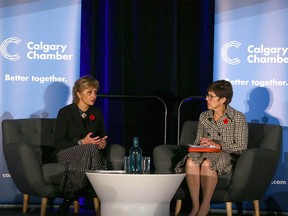
Gondek warned that the province could be forced to step in if the city continued to shirk the difficult tax decision as council narrowly shot down a bid to have residents take on more of the tax burden in February. She sounded the same alarm while speaking with Calgary Chamber of Commerce CEO Deborah Yedlin last week.
“I’d prefer to set our own destiny and make sure we’re making proper decisions in the interest of Calgarians,” the mayor said during a Thursday address to the chamber. “That’s why I’m very focused on doing the right thing this budget season.”
The chamber has long called on the city to alter the tax mix, advocating for a 2.8-to-one ratio, substantially less than the city’s current 4.59-to-one forecast for 2024. Yedlin pointed to a recent chamber survey, which found 90 per cent of its members have been negatively affected by rising commercial property taxes.
Advertisement 4
Article content
Related Stories
‘Do the right thing’: Gondek, Yedlin say property tax ratio needs to change to help business community

Calgary’s business community disappointed as property tax burden set to rise

Council votes to maintain status quo on residential tax share
The executive committee is being asked to forward the report for consideration by the whole of council on Nov. 7 to be considered as part of budget deliberations set to begin two weeks later.
The tax split is expected to be a subject of interest during budget deliberations.
— With files from Scott Strasser
mrodriguez@postmedia.com
X: @MichaelRdrguez
Article content
Share this article in your social network
[ad_2]
Source link
