



[ad_1]
Receive free World updates
We’ll send you a myFT Daily Digest email rounding up the latest World news every morning.
A closely watched gauge of long-term inflation expectations in the eurozone has reached its highest level since 2010, in a sign that some investors think the European Central Bank will struggle to bring inflation back to its 2 per cent target.
The so-called five-year, five-year forward inflation swap — a measure of markets’ assessment of price growth over the second half of the next decade — hit 2.66 per cent this week, despite signs that the current burst of inflation has peaked as tighter monetary policy takes effect.
Lombard Odier estimates the eurozone’s inflation could be as much as 1.5 percentage points on average higher in the decade to 2032 than it was in the previous 10 years, as rising energy and goods prices, exacerbated by Russia’s invasion of Ukraine, feed through to wage demands.
The increase in long-term inflation expectations could be uncomfortable for the ECB, which has hinted that it is close to the end of its tightening cycle after delivering nine consecutive interest rate rises, lifting its deposit rate to a 22-year high of 3.75 per cent last month.
Inflation expectations have edged higher in most big economies in recent weeks, driven partly by climbing oil prices. But the rise is particularly notable in the eurozone, where inflation was persistently below the ECB’s target in the decade after the 2008 financial crisis.
Here’s what else I’m keeping tabs on today:
Economic data: Russia reports its consumer price index for last month.
Results: Streaming losses, TV woes and box office flops are expected to eat into Disney’s profits when it reports earnings today. The media group announced a $2bn push into US sports betting yesterday, tying its ESPN cable network to Penn Entertainment. Others reporting include ABN Amro, Bellway, Generali and Hill & Smith.
Five more top stories
1. Exclusive: The UK government is resisting moves to close loopholes in corporate transparency laws made by some members of the House of Lords aiming to crack down on dirty money passing through Britain. In a letter seen by the Financial Times, the government said it opposed making information on beneficiaries of trusts available to the public without a consultation on grounds of individual privacy. Read the full story.
2. US banks suffered almost $19bn of losses on soured loans in the second quarter, up 17 per cent on the previous three months and the highest level in more than three years. Lenders lost 61 cents for every $100 loaned, as they contended with rising defaults among credit card and commercial real estate borrowers. But some analysts say the losses reflect a return to normality.
3. Exclusive: Google and Universal Music are in talks to license artists’ melodies and voices for songs generated by artificial intelligence. The goal is to develop a tool for fans to create such tracks legitimately and pay for copyright, with artists given the choice to opt in. Here’s how the industry is trying to monetise the “deepfake” threat.
4. Italy has partially backtracked on its planned windfall tax on banks after bank shares dropped sharply. The government said it would limit the levy on net interest income to 0.1 per cent of risk-weighted assets, a fifth of the level analysts had expected the tax could reach. Here’s more on Rome’s efforts to ensure “financial stability”.
5. Germany has offered to extend the deployment of three Patriot air defence systems to Poland from its original due date in June to the end of the year, as part of a broader Nato effort to strengthen its eastern flank in the wake of Russia’s war on Ukraine. The move from Berlin bows to a demand from Warsaw at a time of tense relations between the two countries.
The Big Read

China is by far the lowest-cost and biggest supplier of many of the key building blocks for clean technologies — 90 per cent of the world’s production of rare earth elements, at least 80 per cent of all the stages of making solar panels and 60 per cent of wind turbines and electric-car batteries. With this dominance adding to growing geopolitical competition and potentially complicating the world’s fight against global warming, the stakes are very high.
We’re also reading . . .
Impact of war: European companies have already taken a big hit from Russia’s invasion of Ukraine, but there is still more pain to come, writes Peggy Hollinger.
UK politics: Prime Minister Rishi Sunak and his Conservative party have in recent weeks stepped up their attacks on Labour, in a sign that campaigning has already started ahead of polls next year.
Biden’s Middle East push: The US plan to normalise relations between Israel and Saudi Arabia would remake the region, but it faces big obstacles.
Chart of the day
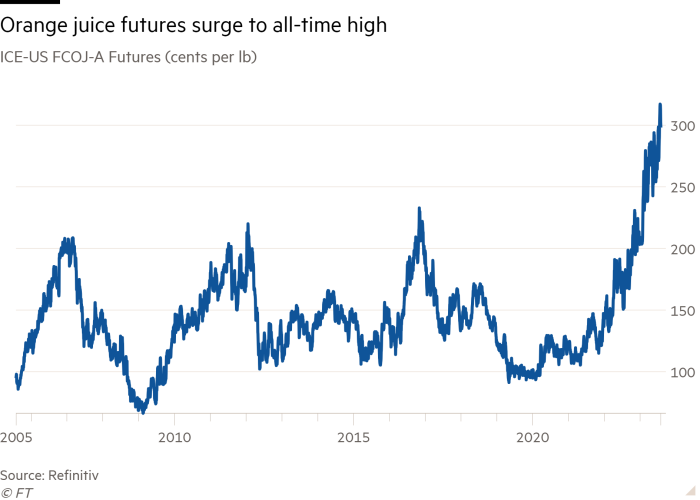
Orange juice futures have surged to all time-highs as a series of hurricanes and the spread of an incurable disease have devastated thousands of acres of citrus crops in the US.
Take a break from the news
From heavenly cannoli in Taormina to handmade pasta in slow-cooked ragù paired with Etna wine, follow FT Globetrotter deputy editor Niki Blasina on the ultimate culinary tour of Sicily.

Additional contributions from Benjamin Wilhelm and Gordon Smith
Recommended newsletters for you
Asset Management — Find out the inside story of the movers and shakers behind a multitrillion-dollar industry. Sign up here
The Week Ahead — Start every week with a preview of what’s on the agenda. Sign up here
[ad_2]
Source link
