



[ad_1]
In the 1956 film, Invasion of the Body Snatchers, extraterrestrial seed pods replicate individuals and replace them with identical-looking, emotionless automatons. My first week at Columbia, Phillip Cagan, the serious-faced, reedy-voiced director of graduate studies seemed to promise to do something similar to us newcomers. Standing before us at our first gathering as a class, he rubbed the back of his own head, as was his habit while speaking, and told us something along the lines of:
“This is a department of economics. After you finish here, you’ll think economics, eat economics, drink economics, walk economics, talk economics, sleep economics, and dream economics. You’ll filter every thought you have through economics.”
Some of us sat in silent fear of this pledge to rewire our brains for some as-yet-unknown process. It sounded like the early stages of recruitment into a cult.
In the 44 years since, I’ll have to say that Cagan’s promise was absolutely on the mark, but the results turned out to be humanizing, rather than dehumanizing. Economic methodology, in turned out, demanded a level of respect for humanity that is often missing in other social sciences. In studying how people make choices, for example, economists don’t presume that, “People drive too fast because (unlike me) they’re too stupid to understand the dangers.” Economists, instead, must ask, “Why do intelligent people drive too fast, given that they know and understand the dangers of doing so?” It turns out that assuming that people are smart is more challenging than assuming they’re stupid. But assuming they’re smart yields far greater insights.
All of the above is from Robert F. Graboyes, “The Minds of Economists,” Bastiat’s Window, January 31, 2024.
I had planned to put this on my Weekly Reading that I post on Sunday, but the whole thing is so good that it deserves its own post.
What I found particularly heartwarming was his story about C. Lowell Harriss. Harriss lived from 1912 to 2009. Often, I would get a letter from him after I had published an op/ed in the Wall Street Journal or even, occasionally, in less well-known publications. He would often comment briefly, sometimes to praise, sometimes to criticize gently, and would enclose a host of cartoons. He would always say. “No reply expected.” Unfortunately, therefore, I didn’t reply except maybe once, and I now wish I had replied more. He was such a gentleman.
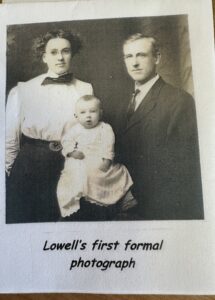
Fortunately, I kept a file of many of his letters. In one, he enclosed his first formal photograph. It’s above.
[ad_2]
Source link
